The leaves are down now, and that corner is showing again.
You know the one. The strip along the north side of the house, or the bed under the maple where the grass gave up years ago and the mulch just sits there looking tidy and a little sad. You've meant to do something with it since last spring. Maybe the spring before that.
I think I know what stopped you. Somewhere along the way, shade got a reputation. Shade means nothing blooms. Shade means a hosta, and then another hosta. Shade means you spread more mulch and call it finished.
I'd love to talk you out of that. Every plant on this list has sat on our benches, and every one of them is happy in a spot that only gets a few hours of sun. One of them will change your mind about shade all by itself. Shade isn't the problem. It just needs a different list.
What "part sun" actually means (and when to count it)
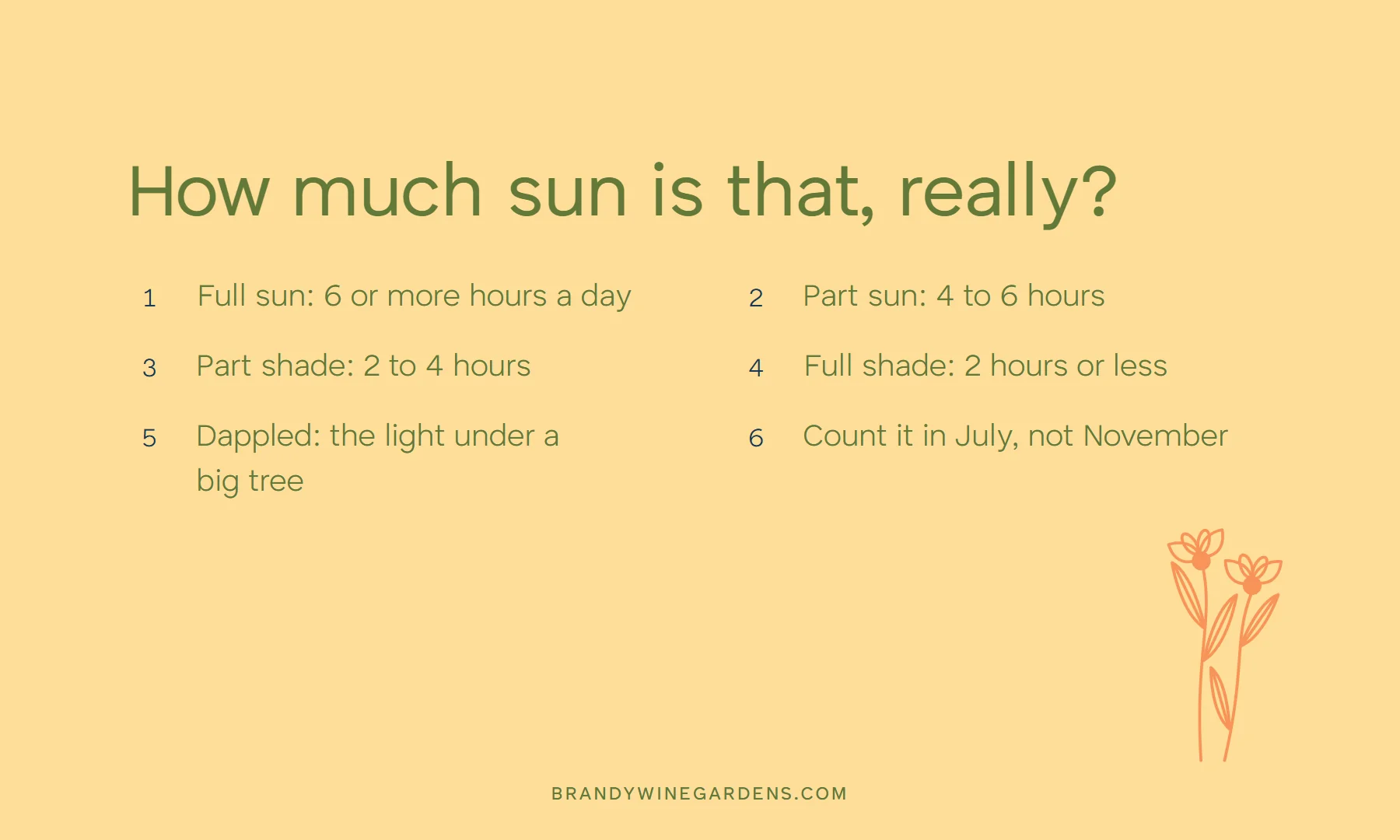
Plant tags use "part sun" and "part shade" as if everyone agreed on them. Nobody did, so here is the ruler we use. Penn State Extension's shrub guide draws the lines like this:
- Full sun: 6 or more hours of direct sun a day
- Part sun: 4 to 6 hours
- Part shade: 2 to 4 hours
- Full shade: 2 hours or less
- Dappled shade: the shifting light under a mature tree
Two things turn that list from tidy into useful.
First, count in summer. The guide is clear that those hours are meant as a mid-summer observation, and that matters: the bare corner you can see from the window today is getting far more light than it will in July, once the maple has leafed out and the sun is overhead. Count your sun in July, not in November.
Second, not every hour is the same. The University of Minnesota Extension puts it simply: morning sun is less intense, and afternoon sun is stronger and warmer. That is why our own Chester County Master Gardeners suggest giving plants that prefer less sun their sunshine in the morning and their shade in the hotter part of the day. A spot that is lit at breakfast and quiet by two o'clock is the sweet spot for everything below.
The easy version of a light study: on a sunny summer day, notice that corner at breakfast, at lunch, and in the middle of the afternoon. If it gets its sun early and then goes shady, you have part shade, and this list is for you. If it bakes from noon on, it isn't the spot for these plants, and that is a good thing to know before the money is spent.
The five plants
Every description below is from our own bench cards and our shade garden series, so what you read here is what you'd read on the tag.
1. Annabelle hydrangea (Hydrangea arborescens 'Annabelle')
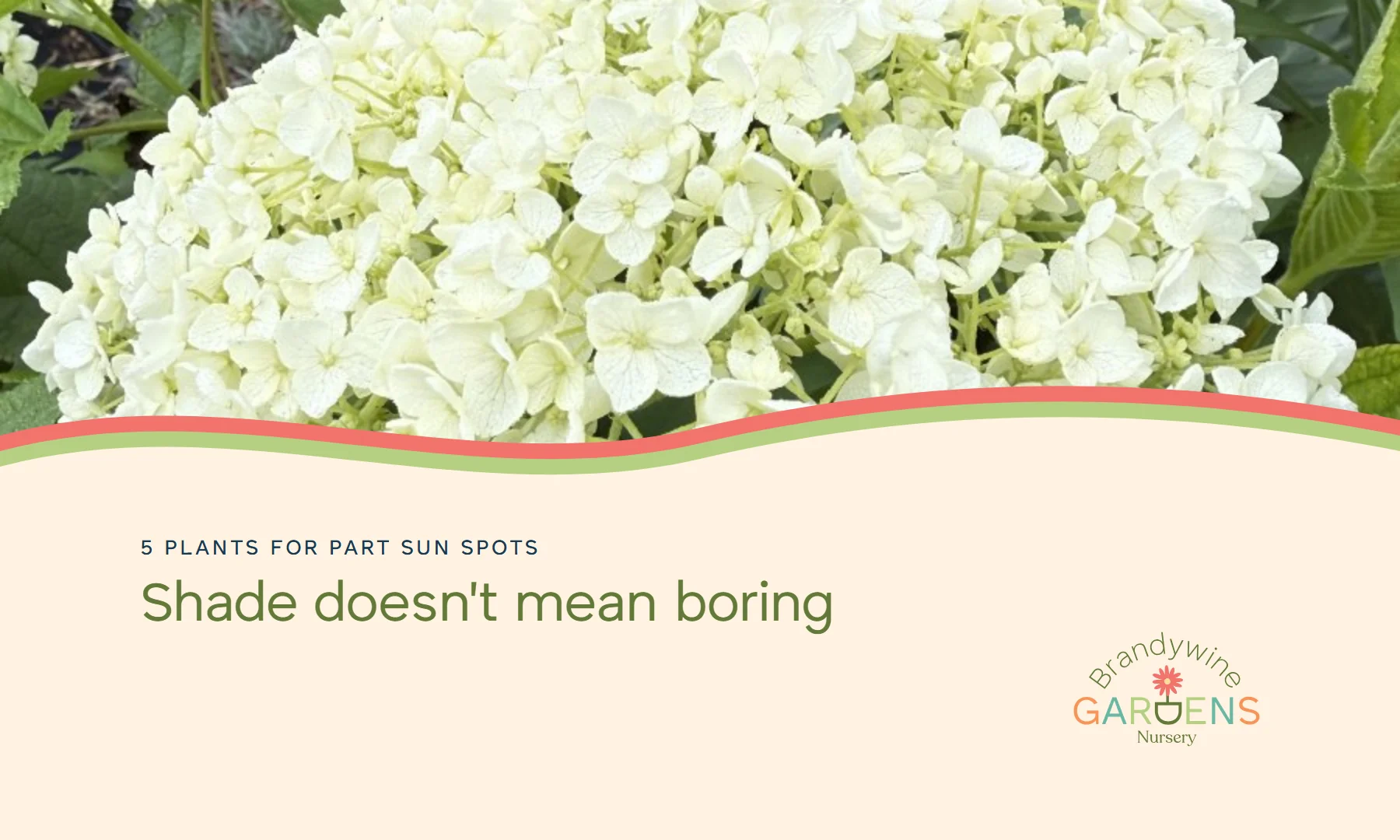
If you plant one thing from this list, make it this one. Annabelle is a native favorite, and its giant white flower heads brighten even deep shade. It blooms on new wood, which just means the flowers come on the stems it grows fresh each spring, so it is a reliable showpiece year after year.
Give it room. Our card has it at 3 to 5 feet tall and 4 to 6 feet wide, happiest in part shade to full shade, in moist, well-drained soil. That width is the detail people miss: a shrub that wants 5 feet across does not belong 18 inches from the downspout. Put it at the back of the corner, where the shade is deepest, and let it be the thing you see from the window.
2. Fragrant Snowball viburnum (Viburnum carlesii 'Fragrant Snowball')
This one is for the nose as much as the eyes. It's a spring bloomer, loved for its fragrant pinkish-white flowers and its compact shape, and it tolerates partial shade, especially with morning sun. Of the five, this is the one to give the brightest spot you have: the edge of the corner that catches the early light.
Put it where you'll walk past it in bloom. Beside the steps, along the path to the door, under a window you open. A fragrant shrub planted at the far end of the yard is a gift to the neighbors.
3. Hosta 'First Frost'
Yes, a hosta. But not the plain green one from the side of every house.
A hosta is a foliage plant, so the show is the leaves, and these leaves are worth the spot: 'First Frost' is an award-winner with frosty blue leaves and golden edges. It's perfect for full or partial shade, easy to grow, and a striking companion for azaleas. Plant it in front of the viburnum or beside the hydrangea, where the blue reads against the green and the white.
4. Coral bells 'Plum Pudding' (Heuchera 'Plum Pudding')
Coral bells are the plant for the front of the bed. 'Plum Pudding' has deep purple foliage and delicate flowers, and it adds stunning contrast beneath taller shrubs, which is exactly where it goes here: tucked in front of the Annabelle, so the purple sits under all that white. It's deer resistant and thrives in shade to part sun.
If your corner is the dry kind of shade, under the eaves or an overhang where the rain barely reaches, this is a good one to lean on. The University of Minnesota Extension names heuchera and hosta among the plants to choose for exactly that spot.
5. Anemone 'Whirlwind' (Anemone x hybrida 'Whirlwind')
Most shade lists stop at spring. This is the one that finishes the year. 'Whirlwind' is a late-season bloomer with elegant white flowers on tall stems. It thrives in part shade, adds fall interest, and the pollinators like it too.
Give it a spot where those tall stems can rise behind the coral bells and in front of the shrubs, and the corner that used to go quiet by fall gets a second act.
If you have room for one more
Those five are a start, not the whole list. Three more from our shade garden series that belong in a shady corner:
- Azalea 'Rukison': soft pink spring blooms, a compact habit, and ideal for morning shade or filtered afternoon sun.
- Phlox 'Sherwood Purple' (Phlox stolonifera): a native groundcover that spreads gracefully, with bright violet flowers in spring. It loves part to full shade, woodland edges, and the ground under trees.
- Southern bush honeysuckle (Diervilla sessilifolia): a Pennsylvania native shrub for part to full shade that supports local pollinators. Low-maintenance and adaptable.
Where to put what
A shady corner comes together the way a family photo does: tall at the back, low at the front, and the one with the most personality in the middle.
- Back: the Annabelle, with its full 4 to 6 feet of width, and the viburnum toward whichever edge gets the morning sun.
- Middle: the hosta, where its blue leaves show against the shrubs.
- Front: the coral bells, so the purple sits under the white.
- Rising through the middle in fall: the anemone.
Three more things worth knowing before the shovel comes out.
Mind the water for the Annabelle. Our card asks for moist, well-drained soil, so if the corner is the dry kind of shade, lead with the coral bells and the hosta and give the hydrangea the spot the hose can reach.
Watch the afternoon. If one side of the corner gets hot afternoon sun, that is where nothing on this list wants to be. Save it for something else.
Plant for the view you actually have. Most of us look at our yards from the kitchen window far more than from the yard, so put the Annabelle where the window can see it.
No ground? Use pots
If your shady spot is a porch, a north-facing stoop, or the ground under a big tree where the roots make digging miserable, pots are the answer. The University of Minnesota Extension actually suggests setting containers under trees and near shrubs for exactly that reason, so you are not fighting the roots.
A few rules the extension folks are firm about, and so are we:
- Use potting mix, not soil dug from the garden. The Chester County Master Gardeners are blunt about this one.
- Make sure water can get out. A pot with no drainage is a bathtub.
- Check before you water: push a finger two inches into the mix. Pots dry out faster than beds, and the best time to water is in the morning, when it is cooler.
- Keep plants with the same light needs together in one pot.
- Give pots the same morning-sun, afternoon-shade placement you would give the bed.
A single hosta in a big pot by a shady door is a classic for a reason, and the coral bells make a lovely pot on their own. Penn State's container article says not to be afraid of perennials in pots, and we agree.
Start with one corner
You don't have to plan the whole thing tonight. Pick the one spot you see most, from the kitchen window or the driveway, and choose one shrub and one plant to sit in front of it. That is a shade garden. Everything else can come later, a little at a time.
And if you would like a hand with the choosing, join our email list. It is where we share what is blooming, tips like these, and the day the next sale dates are set. No pressure and no pile of mail, just a note from the nursery now and then.
Warmly, Tina

Homeschooling mom of eight, grandma, and the one who started this nursery from a propagation experiment.